Bitcoin Falls to $64,000 — Bear Market?
BITmarkets Team
Feb 23, 2026

Bitcoin has now fallen below $65,000, marking a decisive breakdown from the previously discussed support structure. The Crypto Fear & Greed Index has reportedly dropped to extremely depressed levels near 5/100 — territory not seen since the early historical readings of the index around 2018–2020, underscoring the severity of current risk-off sentiment.
After a sharp daily sell-off, BTC briefly rebounded toward $66,000, but has since slipped back into the $64,000 range, suggesting continued selling pressure and fragile buyer conviction.
Bitcoin technical analysis
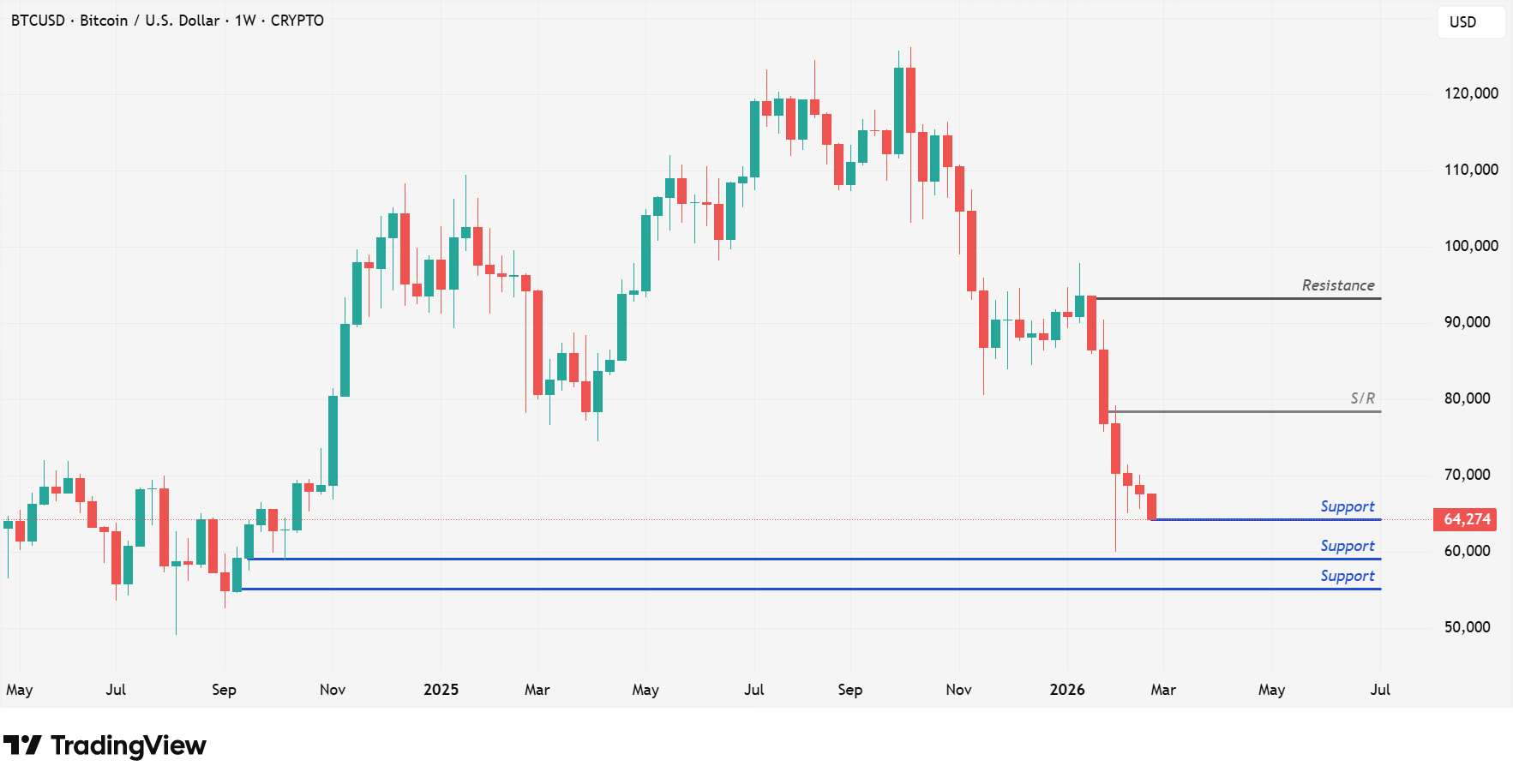
BTCUSD - 1 Week Time Frame
Bitcoin is currently trading slightly above the $64,000 support zone, which now serves as the immediate structural floor. This area aligns with prior consolidation phases and represents the first meaningful demand region following the breakdown from the $78,000–$82,000 range discussed earlier in February.
The technical landscape has shifted materially. The $78,500 S/R level, previously highlighted as a support zone in early February, has now clearly transitioned into resistance following the breakdown. Any sustained recovery attempt would likely target this level first. Reclaiming $78,500 would signal structural improvement and a potential stabilization of broader sentiment.
Above that, the $93,000 resistance zone remains the major upside barrier, though it currently appears distant under prevailing market conditions.
On the downside, failure to hold $64,000 exposes the next significant support areas near $59,000 and $55,000, both of which align with historical demand zones and prior consolidation structures.
Bitcoin price target
At present, Bitcoin appears to be in a high-volatility corrective phase. The key question is whether $64,000 evolves into a durable base or merely a temporary pause within a broader risk-off cycle.
If sentiment improves and selling pressure begins to exhaust, a recovery toward $78,500 would be the first meaningful upside objective. Acceptance above that level would suggest that the breakdown was potentially a liquidity-driven event rather than the beginning of a prolonged structural decline.
However, continued macro uncertainty, geopolitical tensions, and broader market fragility could keep Bitcoin oscillating between $64,000 and former support-turned-resistance at $78,500. A decisive loss of $64,000 would likely shift focus toward the $59,000–$55,000 region.
For now, Bitcoin is testing a critical inflection point. The coming weeks will likely determine whether this phase develops into accumulation at discounted levels or extends into a deeper corrective structure.