Tokenization Explained: Real-World Assets on Blockchain
In simple terms, tokenization is the process of converting ownership or rights to an asset into a digital token on a blockchain. These tokens can represent real-world assets such as government bonds, equities, funds, commodities, or real estate, enabling faster settlement, improved transparency, and broader market access.
Known as tokenized real-world assets (RWAs), this fast-growing segment is bridging traditional finance and blockchain infrastructure, reshaping how capital is issued, traded, and managed in modern financial markets.
Tokenization in finance refers to converting real or financial assets into blockchain-based digital tokens that represent ownership, value, or claims.
From a market perspective, tokenization is not merely a technological upgrade. It represents a structural shift in how capital is issued, transferred, and managed. As financial markets move toward digital settlement layers, tokenized assets are expected to play an increasingly central role in both institutional and retail investment ecosystems.
What Is Tokenization in Finance?
Tokenization in finance refers to creating blockchain-based tokens that represent ownership, value, or claims on real-world assets or financial instruments. These tokens are issued under legal and custodial frameworks that link the digital representation to the underlying asset. Depending on structure, a token may represent direct ownership, fractional ownership, entitlement to yield, or exposure to a financial instrument.
Tokenization allows traditional assets to operate within blockchain environments while maintaining their real-world value linkage. This enables assets historically bound to banks, custodians, or brokers to be transferred across decentralized or hybrid financial networks with improved efficiency and transparency.
Real-world asset tokenization commonly includes:
- Government bonds and Treasury instruments
- Money market funds and fixed-income products
- Public equities and investment funds
- Commodities such as gold or energy assets
- Corporate credit and structured debt
- Real estate and infrastructure holdings
These tokenized instruments form the foundation of the growing RWA market, which is increasingly viewed as a bridge between decentralized finance (DeFi) and traditional financial systems (TradFi).
Benefits of Tokenization and Tokenized Assets
Tokenization introduces several structural improvements that are reshaping financial market infrastructure.
Faster and more efficient settlement
Traditional financial settlement often requires multiple intermediaries and delayed clearing cycles. Tokenized assets can enable near real-time settlement depending on legal and technological structure, reducing friction and counterparty risk.
Global accessibility and continuous markets
Blockchain infrastructure operates continuously, allowing tokenized assets to be accessed across time zones without reliance on traditional market hours. While liquidity varies by asset class, tokenization creates the foundation for always-available financial markets.
Fractional ownership and improved capital distribution
Tokenization enables large assets to be divided into smaller digital units. This can reduce minimum investment thresholds and expand distribution potential while improving capital efficiency.
Programmable financial logic
Tokenized assets can embed automated rules such as compliance checks, dividend distribution, coupon payments, collateral logic, and governance mechanisms. This programmable nature is one of the most transformative features of blockchain-based finance.
Transparency and auditability
Blockchain records provide verifiable tracking of token issuance, transfers, and supply. While transparency does not eliminate risk, it can reduce opacity and improve monitoring compared to traditional closed systems.
Why Tokenized RWAs Matter in Today’s Market
Tokenized real-world assets are gaining traction as global finance increasingly moves toward digital settlement and blockchain-based infrastructure. Institutional forecasts increasingly suggest that tokenization may reach significant scale within the coming years.
Standard Chartered has projected that tokenized RWAs could approach $2 trillion in value by 2028, representing a substantial expansion from current market levels. A large portion of this growth is expected to come from tokenized money market funds, equities, and investment products.
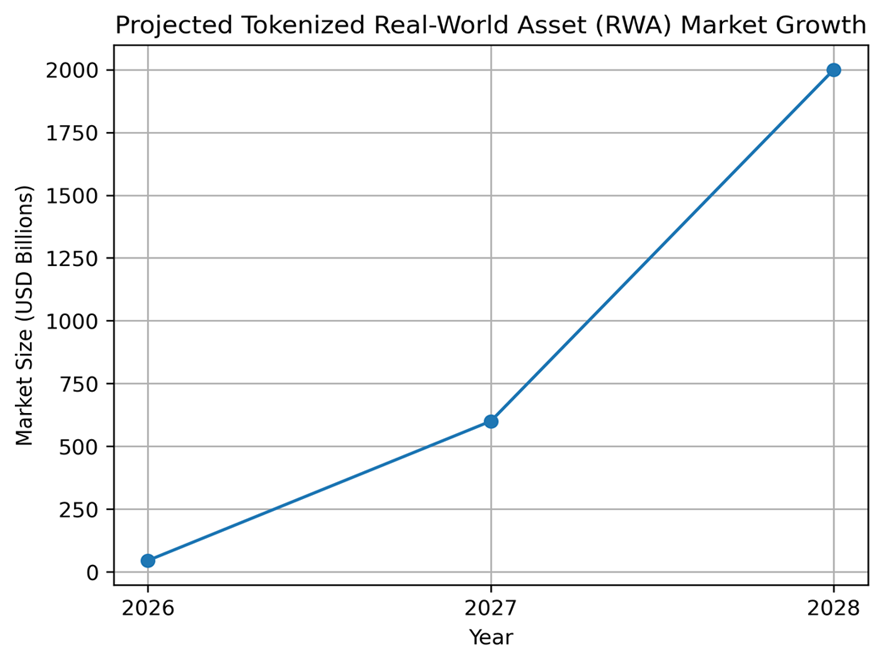
Source: Standard Chartered Digital Assets Research, RWA.xyz
The expansion of tokenized assets is closely tied to the growth of stablecoins, which function as the primary liquidity layer of blockchain-based finance. Stablecoins provide the settlement currency used to trade, hedge, and collateralize tokenized instruments. As stablecoin supply expands, it strengthens on-chain liquidity and enables the creation of additional financial products, reinforcing a self-sustaining cycle of blockchain market development.
This interaction between stablecoin liquidity, decentralized finance infrastructure, and tokenized real-world assets is one of the key drivers behind the broader convergence of traditional and digital finance. As institutional adoption grows, tokenized assets are increasingly viewed as a core pillar of next-generation digital financial infrastructure.
Market Implications for Traders and Investors
For traders and investors, tokenization introduces new dynamics that may influence liquidity, yield structures, and cross-market correlations.
On-chain yield benchmarks
Tokenized Treasury and money market instruments introduce relatively stable yield-bearing assets into blockchain ecosystems. These instruments can influence borrowing costs, leverage conditions, and capital allocation across decentralized finance markets.
Extended exposure to traditional assets
Tokenized equities and funds may enable broader trading windows and increased interaction between crypto markets and traditional financial markets. This could affect volatility patterns, particularly outside traditional market hours.
Tokenized illiquid assets
Tokenization of real estate, private credit, and commodities has the potential to improve accessibility, but underlying liquidity constraints remain. Pricing behavior and market depth may differ significantly from traditional exchange-traded instruments.
Key Risks to Consider
Despite strong growth potential, tokenized assets carry important risks.
Regulatory uncertainty
Tokenized securities and financial instruments operate across multiple legal jurisdictions. Regulatory clarity remains a primary factor influencing adoption and institutional participation.
Technology and smart contract risk
Tokenized assets rely on blockchain infrastructure, which may be exposed to coding errors, exploits, or governance vulnerabilities.
Custody and legal enforceability
The value of a token depends on the strength of the legal framework linking it to the underlying asset. Investors must evaluate issuer structure and custodial arrangements carefully.
Pricing and oracle risk
Some tokenized assets depend on external pricing sources or valuation models that may lag or experience disruptions.
The Long-Term Outlook
Tokenization is widely viewed as a foundational development in modern finance rather than a temporary innovation. As capital markets continue to digitize, tokenized real-world assets are expected to play an expanding role in settlement infrastructure, investment distribution, and liquidity formation. The integration of traditional financial instruments with blockchain technology has the potential to reshape how assets are issued, traded, and managed globally.
For traders and investors, understanding tokenization and tokenized real-world assets is becoming increasingly important. As blockchain-based finance matures, tokenized assets may influence yield benchmarks, liquidity cycles, and cross-market behavior. While the technology introduces efficiency and transparency, disciplined risk management and clear understanding of asset structure remain essential when navigating this evolving segment of global markets.


